Learn how to unlock the power of your first-party data with a composable commerce media network. Download the ebook now!

Key takeaways:

  • Agentic marketing reflects the rapid evolution of AI and the competitive necessity to deliver highly personalized, consistent experiences at scale.

  • Transforming into an agentic marketing organization requires alignment across the technology stack, team structure, and ongoing transformation.

  • Agentic AI isn’t effective without a data cloud-centric, composable architecture — it requires a completely connected tech stack to access all customer data and orchestrate activities across tools.
What is agentic marketing?

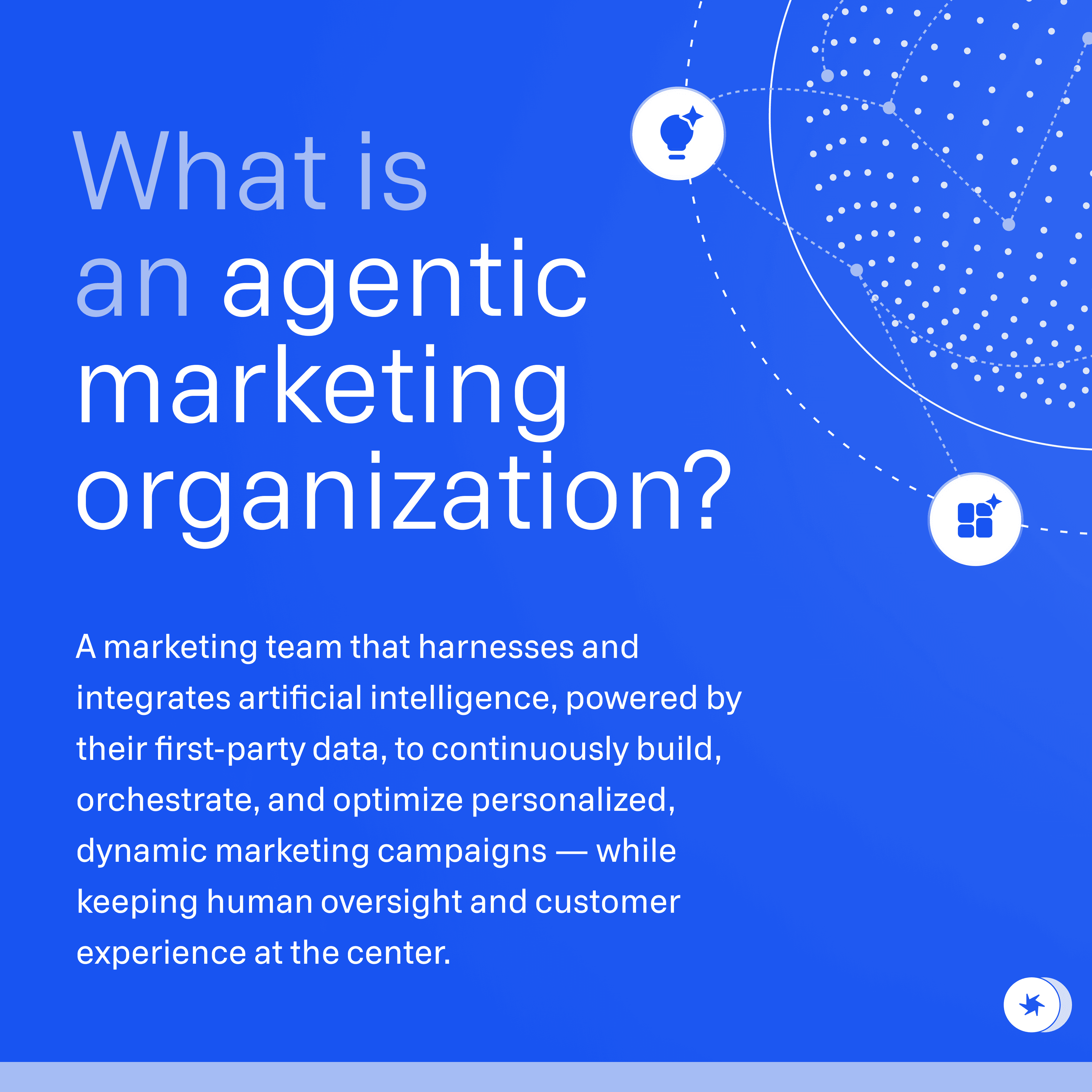
Agentic marketing is a mindset and a model that empowers marketers to partner with AI agents to experiment and iterate campaigns faster, leading to compound marketing growth

Agentic marketing reflects the rapid evolution of artificial intelligence and the competitive necessity to deliver highly personalized, consistent experiences at scale. By augmenting humans with AI, organizations can overcome the hurdles of traditional marketing approaches and:

  • Automate manual, error-prone tasks, so marketers focus on high-value activities.

  • Constantly surface new audiences and customer journeys based on first-party data intelligence.

  • Deliver personalized messages and refine campaigns at scale to achieve organizational goals.

How is agentic marketing different than traditional marketing?

Marketing teams have historically been held back by disconnected technologies, data silos, and process bottlenecks. Marketing cycles are notoriously slow, often requiring weeks or months to launch a campaign from idea to measurement, and teams lack the agility to adapt campaigns while they’re still active. 

Agentic marketing organizations remove these hurdles so AI can effectively access all marketing systems and data to orchestrate intelligent campaigns. The model integrates AI into every marketing process while keeping humans in the loop at all times. 

How do teams incorporate agentic marketing?

Transforming into an agentic marketing organization requires alignment across the technology stack, team structure, and ongoing transformation. 

Technology

The first step toward becoming an agentic marketing organization is to position customer data in a central, secure location and connect that data to an agentic AI-powered toolset. This involves three key components: 

  • A cloud data warehouse is the ideal data storage location. Data clouds provide optimal data security, give teams flexibility to connect to their preferred channel tools, and serve as the hub for AI activation.

  • Composable marketing technologies connect to the cloud data warehouse to continuously preserve the single source of truth on customers, or customer 360. Agentic AI orchestrates activities across all composable tools, and these tools can be replaced without affecting the rest of the stack.  

  • A composable activation and orchestration layer, such as a Compound Marketing Engine, provides marketers with an intuitive interface to self-serve customer data, build audiences, and collaborate with AI to orchestrate campaigns.

Team structure

After establishing the proper technical foundation for agentic AI, leaders can then adjust their marketing organizational chart. 

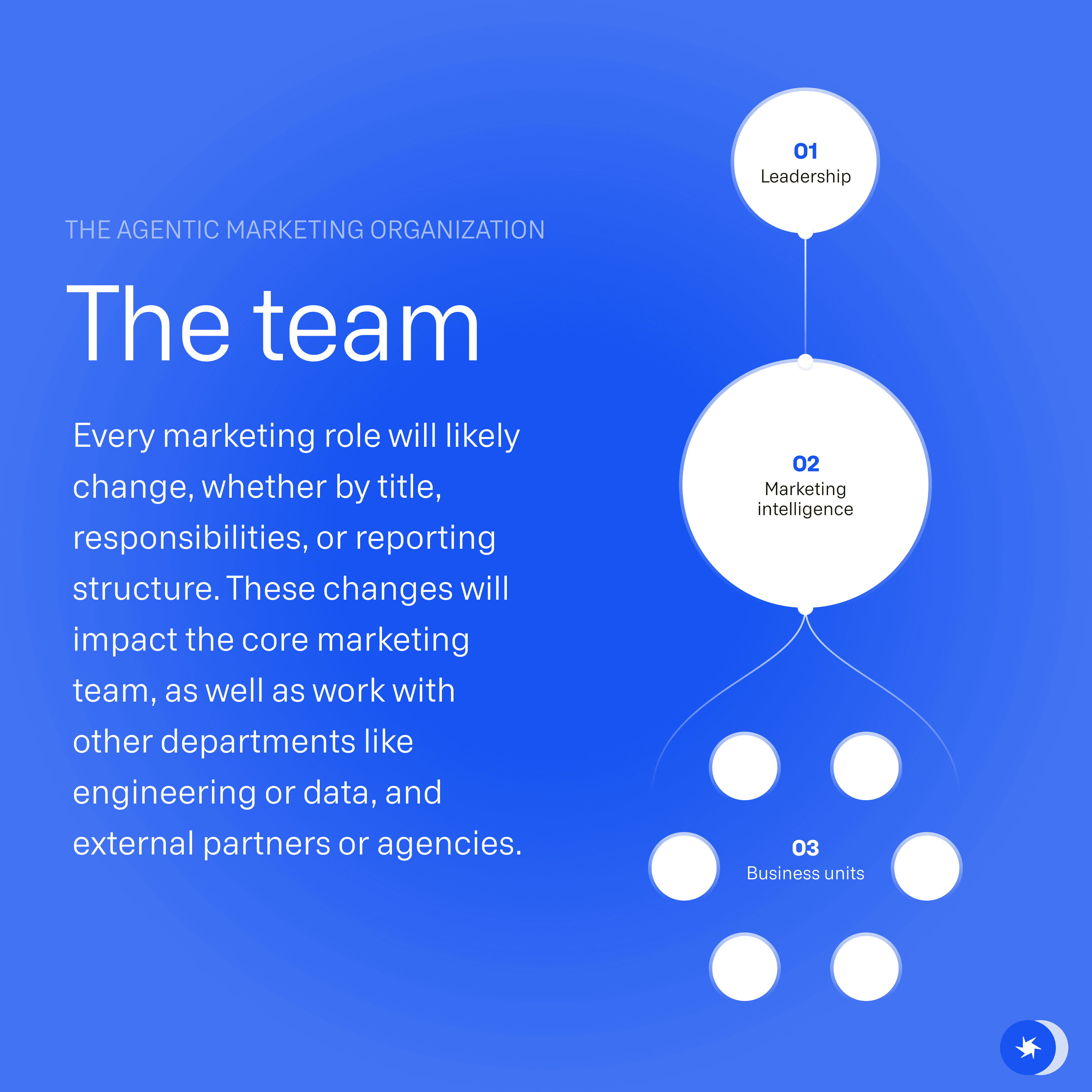
Every marketing role will likely change given AI’s prominent position in an agentic marketing organization, whether by title, responsibilities, or reporting structure. The agentic marketing organization ebook details one possible blueprint, comprised of:

  • Leadership, the strategic core for AI-driven growth that directs key strategic decisions.

  • Marketing intelligence, a technology and AI enablement layer that leads AI model development, data access, and overall marketing stack upkeep.

  • Business units, which are structured around product line or brand pods, or customer journey stage pods.

Transformation

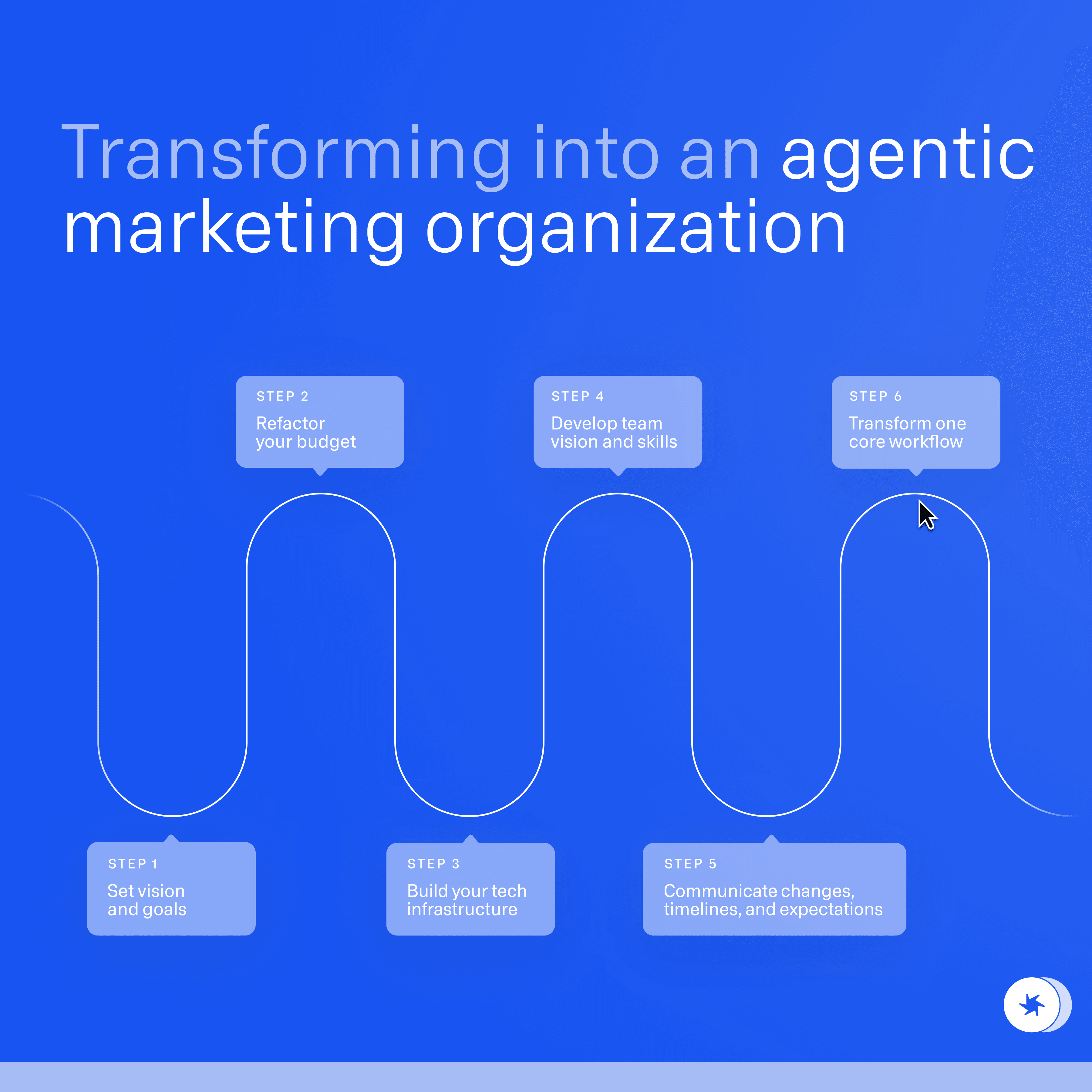
Embracing an agentic marketing mindset requires a strategic, gradual rollout and ongoing adjustments as new agentic AI capabilities emerge.

Organizational leaders should first audit their current team structure and tech stack to determine a realistic path to transformation. They can then refactor their budget to accommodate the transition and build the necessary agentic AI infrastructure. 

Clear communication is essential to help team members adapt to the new setting. By transforming one core workflow at a time, teams can work through potential challenges of the new structure, become skilled at using AI, and confidently measure their success before implementing AI in other workflows. 

Agentic marketing examples

Agentic workflows can integrate with any marketing process across the customer lifecycle, spanning awareness, conversion, and loyalty building. 

Consider this campaign example for a cosmetics brand launching a new product:

  • Audience segmentation - Marketers work alongside purpose-built AI agents that help develop the most relevant and impactful audiences based on business goals. Looking at the organization's overall objectives, like increasing customer lifetime value, the AI agents recommend audiences most likely to improve that metric. Marketers can also prompt the agents with audience ideas and use a chat interface to refine each audience alongside the AI.

  • Journey planning - After AI delivers an approved audience segment, marketers can ask for a campaign journey tailored to each list. AI can suggest the appropriate mix of channels and key messages to rapidly develop the campaign. Humans review every message before the agentic AI system coordinates the outreach.

  • Campaign analysis - Agentic AI continuously monitors campaign results and flags potential opportunities for improvement. Marketers can review AI suggestions and quickly adjust underperforming campaigns while they are still active. 

Each step positions agentic AI to elevate marketers, not replace them. 

Agentic marketing benefits

Agentic marketing is essential for achieving better results and effectively scaling personalization efforts across every touchpoint, even with limited resources. 

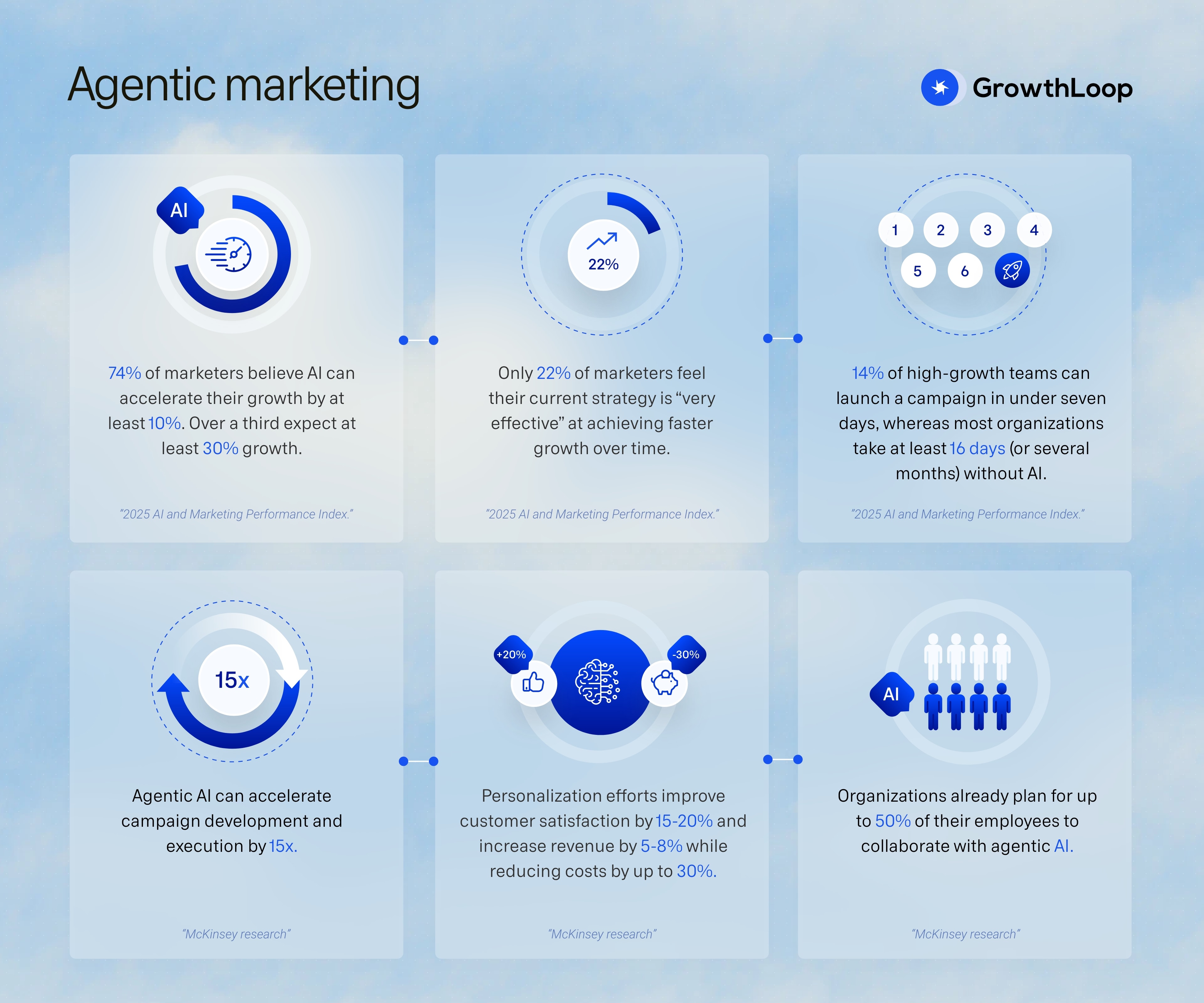
The 2025 AI and Marketing Performance Index reinforced the competitive necessity to adopt AI and its perceived benefits:

  • 74% of marketers believe AI can accelerate their growth by at least 10%. Over a third expect at least 30% growth.

  • Organizations reporting the greatest revenue growth are also more likely to use AI in their marketing processes, especially for predicting customer behavior, automating audience segmentation, and optimizing SEO. 

  • Only 22% of marketers feel their current strategy is “very effective” at achieving faster growth over time. 

  • 14% of high-growth teams can launch a campaign in under seven days, whereas most organizations take at least 16 days (or several months) without AI. 

McKinsey research also validates the importance of agentic marketing:

  • Agentic AI can accelerate campaign development and execution by 15x.

  • Personalization efforts improve customer satisfaction by 15-20% and increase revenue by 5-8% while reducing costs by up to 30%.

  • Organizations already plan for up to 50% of their employees to collaborate with agentic AI.

AI agents vs. automation

AI agents enable data-driven, autonomous orchestration designed to meet organizational goals. They proactively suggest campaign improvements or opportunities to improve results by: 

  • Understanding an organization’s goals for an intended marketing campaign or activation.

  • Continuously monitoring and analyzing customer data to identify opportunities for improvement.

  • Designing messages and customer journeys. 

  • Updating and iterating campaigns in real time based on the data.

Each agent trained in a specific task coordinates with other agents to complete complex marketing activities and cycles. This extends well beyond the capabilities of marketing automation, which uses a simple rules-based system to trigger messages or offers to customers based on signals. 

Agentic marketing challenges to overcome

Despite the booming interest in agentic AI, many organizations have failed to achieve meaningful value from their implementations due to a common set of challenges:

  • Improper technology foundation - Agentic AI won’t work without a data cloud-centric, composable architecture. Teams are often eager to jump right into applying agentic AI, so they rely on standalone capabilities in channel tools. However, effective agentic marketing requires a completely connected tech stack so AI can access all customer data and orchestrate activities across tools. Composable solutions built around the data cloud are the only way to enable agentic AI. 
  • Pilot project silos - Individual marketers or channel teams may find innovative AI solutions without sharing their learnings with other teams. Or, they try to apply AI to complex tasks that make it challenging to measure value and scale use cases. To overcome this challenge, organizations can promote information sharing and create an agentic AI council with representatives from every department to discuss their AI activations, share results, and brainstorm solutions to problems.

  • Legacy workflows - Instead of bolting agentic AI onto existing workflows, teams should consider how to reinvent their workflows to best blend human and AI abilities. 

  • AI literacy - Working with agentic AI is an entirely new skill. Employees need resources, training, and ongoing support as they learn to partner effectively with AI. Organizations should develop targeted AI training and seek vendors that provide robust onboarding resources, enabling employees to quickly hit their stride.